History and Coat of Arms

Thanks to the amalgamation of a small village and several local service districts, on May 8, 1995, our beautiful valley – the Village de Memramcook was born. Memramcook is a great place to live, where people want to put down their roots. And today still, Municipal Officials continue to work hard to develop this young community overflowing with potential.
Cradles are closely linked to births. And since it was in Memramcouke where most Acadians rallied after the Deportation and the loss of their lands, it is quite natural to refer to this area as the “Cradle of New Acadia”. It was in Memramcouke where dispersed Acadians re-established their homes. Bit by bit, the Acadian spirit slowly rekindled itself and began breathing life into the newly settled Acadian communities hugging the three Maritime Provinces’ coastline. It is therefore no surprise that Memramcouke finds in its midst New Acadia’s oldest religious parish (1781) and the first Acadian college (1854 - Séminaire St-Thomas). Closed in 1862, the Séminaire reopened its doors under Collège Saint-Joseph in 1864. In fact, this is where the First National Acadian Convention took place in 1881. No other Acadian village has spun off as many other villages as has Memramcouke. That in part explains why folks from Memramcouke have relatives living all over Acadia. Memramcouke really is the cradle that reenergized Acadians to rebuild their lives and their villages (inspired by the text of Donatien Gaudet in “Passe-Pierre et les Jeux”).
Dating back to 1700, the Parish of Memramcook’s first settlers were aboriginal peoples from the Mi’kmaq tribe who made their home along the river. Did you know that “Memramcook” is a Mi’kmaq name that, according to some, means “crooked river”? Many controversies marked the final spelling choice of the parish’s name (for example: Memramcouke). At the beginning, it was written “Memeramcouque”, and then it became “Mamramkook”. Finally, after many years, the spelling “Memramcook” was universally adopted.
Memramcook, like many other Acadian villages settled before the Deportation, was built around 1700 near salt marshes. Even today, these marshes still hold dikes and aboiteaux than can be visited and admired. And, at certain times of the year, samphire grows there in great big quantities.
To learn more about the history of our beautiful valley, please visit the Société d'histoire de Memramcook website.
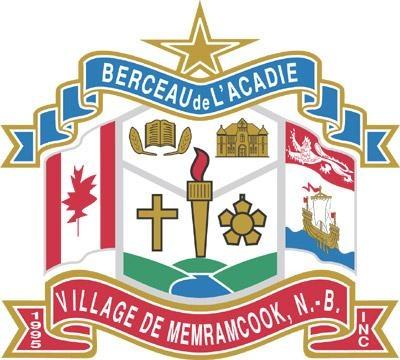
On May 8, 1995, the amalgamation of a small village and several local service districts gave birth to our beautiful valley – the Village de Memramcook. Following this incorporation, the municipality wanted to acquire its own coat of arms. Containing key symbolic elements, our coat of arms appears on official documents as well as on the municipality’s flag.
Star - Acadian Survival
Cross - Religion and Culture
Book - Education
Building - Institution
Medal and Feathers - Governor General of Canada
Water - Unity
Flame - Hope
Greenery - Agriculture and green spaces
Colors – Gold, Red and Blue - Colors of the Acadian Flag
To the left - The Canadian Flag
To the right - The New Brunswick Flag
The Village of Memramcook was granted a project through the New Brunswick Local Historic Places Program, offered by the Department of Wellness, Culture and Sport. Through this program, municipalities, in partnership with local heritage preservation groups, can identify and designate local historic places within their communities.
From September 2005 to December 2009, the municipal council at the time, in collaboration with the Société historique de la Vallée de Memramcook, adopted resolutions at various council meetings to recognize and designate significant sites as local historic places within the municipality.
These initiatives demonstrate the municipal council’s commitment to the preservation, conservation, and promotion of our local heritage.
The following are the sites:
- Beaumont Quarry
- Belliveau Orchards
- Belliveau Village Wharf
- Birthplace of Roméo LeBlanc
- Butte à Pétard
- Croix de la Montain
- Former Gayton School
- Former Mi'kmaq Reserve at Beaumont
- Former Saint-Joseph School
- Gayton Covered Bridge
- Lourdes Grotto
- Lower Petitcodiac River
- Memramcook Marsh
- Monument Lefebvre
- Monument-Lefebvre National Historic Site of Canada
- Notre-Dame de l'Annonciation Church
- Notre-Dame de Lourdes Church
- Sainte-Anne-de-Beaumont Chapel
- Saint-Thomas de Memramcook Church
- Saint-Thomas de Memramcook Parish Catholic Cemetery
- Statue of Father Camille Lefebvre
- Sylvain Gaudet House
- Tilmon Bourque House
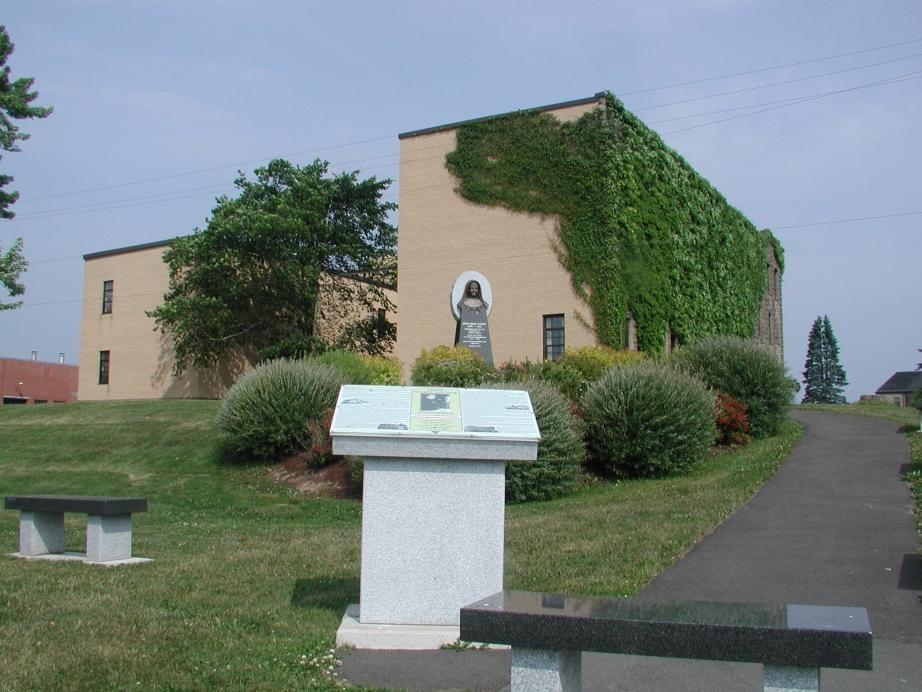
 Unveiling of the monument and plaque of the Blessed Mother Marie-Léonie - September 11, 2005.
On an idyllic day, over 350 people attended the unveiling of the monument and plaque dedicated to the Blessed Mother Marie-Léonie in Memramcook.
With this ceremony, the hard work of four dedicated committee members finally paid off. Thanks to Bertille Demers’ tenacity and perseverance, this important project was finally realized. Bertille worked hard researching, gathering documents and corresponding with the Mother-House of the Congregation of the Holy Family located in Sherbrooke, Québec. In fact, she worked by herself for a whole year before calling upon the public to help her with the project. That is when Marie-Stella Gaudet, Germaine Cormier and Dollard Dupuis joined her and began putting together the financing needed for the monument. The artist Claude Roussel was then chosen to create the bust which would be included in the monument unveiled on Sunday and blessed by Mgr André Richard. (Excerpt taken from the newspaper L’Étoile, article by Roméo LeBlanc, September 17, 2005 edition.)
The bust commemorating the Blessed Mother Marie-Léonie is made of bonze and its base is made of granite. The monument measures approximately 2,65 meters, or about 9 feet.
Born on May 12, 1840 in the village of L’Acadie in Québec, Alodie-Virginie was the daughter of Joseph Paradis and Émilie Grégoire. Known as Élodie, she was to become the founder of the Little Sisters of the Holy Family.
In February 1854, Élodie entered the convent as a novice with the Marianite Sisters, the female branch of the Congregation of the Holy Cross. It was on August 22, 1857 that she pronounced her vows. She primarily devoted herself to teaching in the Montréal region until 1862. Then, she decided to move to New York to work at the Saint-Vincent-de-Paul orphanage. Finally, in 1870, she decided to join the American branch of the Sisters of the Holy Cross located in Notre-Dame, Indiana (USA).
In 1872, Father Camille Lefebvre, c.s.c., as provincial superior, was sent to Notre-Dame, Indiana, to attend his congregation’s general chapter meeting. During his stay, he took notice of a small community of nuns dedicated to the duties of housekeeping. He thought to himself “such sisters could do good in Acadia».
Father Lefebvre made an appeal to members of this religious community to join him in Memramcook and take up housekeeping duties at the Collège Saint-Joseph where he was headmaster. In September 1874, four sisters accepted to leave Indiana for Memramcook. However, none of them spoke French.
The following month, at Father Lefebvre’s request, Sister Marie-Léonie and Sister Marie-Philomène arrived in Memramcook to join the four Americans. Sister Marie-Leonie was immediately given the task of overseeing the new community while Sister Marie-Philomène was made responsible for the sick ward.
In the beginning, there was very little room for the Sisters. The old wood-built church rectory housed both the convent and the sick ward on the second floor. As for the first floor, the space was occupied by a laundry and linen room and a small chapel measuring only 8 square feet. Two years later, when a new stone building was finally built for the Collège Saint-Joseph, the small community of sisters moved into the old college which then became a convent.
Soon, it was proposed to form a religious community serving the needs of the Collège. However, the Bishop of Saint-Jean was slow to give his approval. Finally, on May 31, 1880, Father Lefebvre, after returning from a General Chapter meeting in France, declared: “I the undersigned attest that upon the explanations given by me to the General Chapter of the Congregation of the Holy Cross, on April 18th 1880, at the Collège de Neuilly in France, near Paris, the aforesaid Chapter will allow the existence of a congregation made up of women which will be known as the Little Sisters, a community dedicated to providing housework to members of the Holy Cross in the province of Canada”. The attestation also specified that the Little Sisters would have the Holy Family as patron saint and that from this day forward they would be known as the Little Sisters of the Holy Family.
The new community received an unexpected boost with this news and many young Acadians joined its ranks and donned the habit during the years that followed. During this time, in order to house the growing community, the old college was expanded and renovated, giving it a modern convent look. Unfortunately, in 1933, the convent succumbed to the fire that also destroyed the Collège Saint-Joseph. It was therefore replaced by the building that still exists today.
While having obtained the approval of the General Chapter of the Congregation of the Holy Cross, the new congregation never received the official blessing of the Bishop of Saint-John. It was only in 1895 that Bishop Larocque, the Bishop of Sherbrooke, came to an understanding with Mother Marie-Léonie and extended his blessing. Upon the terms concluded, Mother Marie-Léonie would have to leave Memramcook to establish the mother house and prepare novitiates of her congregation in Sherbrooke. At her departure, that same year, she said: “I did not know my heart was so attached to Memramcook.” This departure greatly saddened the population of the Valley as well as the sisters remaining behind to continue their work at the Collège Saint-Joseph.
Official recognition of the Little Sisters community was finally passed on January 26, 1896, two days before the anniversary of Father Lefebvre’s death and on the day celebrating the Holy Family. Mother Marie-Léonie had then said: “Our Father Lefebvre is more powerful up there than he was down here”.
From the time she arrived in Memramcook, Mother Marie-Léonie had always worn the habit of the Holy Cross religious community. In 1905, Pope Pie X allowed her to wear the habit of the Little Sisters, which she then wore during the last seven years of her life until her death on May 3, 1912.
Throughout her life, Mother Marie-Léonie was a charitable person who tried to alleviate human suffering and misery. Her devotion still remains alive today in the hearts of those who knew her and who passed down her legacy and faith to their descendants. She went to God with the confidence of a child, her faith making her see and serve Christ by ministering to his servant, the Priest.
Mother Marie-Léonie was the first person to be beatified in Montréal during a ceremony presided by Pope Jean-Paul II, in 1984, when it was said that she was « the humblest of the humble ».
With this monument, Memramcook wants to honor and celebrate the one who dedicated herself to serving the needs of others and who founded a religious community in the enchanting valley. Even today, the Blessed Marie-Léonie continues to answer the prayers of those who need her.
